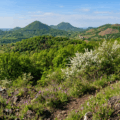
Between April and June, the Euganean Hills enter their most dynamic and scientifically interesting phase. It is not merely spring in the poetic sense of the term, but a true ecological process of reorganization: light increases, temperatures stabilize, soil moisture is redistributed, and vegetation begins the most intense growth cycle of the year. Over these weeks, the landscape changes with remarkable speed, yet according to precise rules studied in botany and Mediterranean ecology.
April: the physiological awakening of the landscape. In April, in the Euganean Hills, vegetation emerges from the so-called winter dormancy phase, a condition in which plants minimize metabolic activity to conserve energy. With rising average temperatures and the lengthening of the photoperiod—that is, daylight hours—chlorophyll production is activated and the growth of plant tissues resumes.
It is the month of the first widespread blooms:
- wild blackthorn and hawthorn, which paint the forest edges white
- spontaneous orchids, particularly abundant in dry, calcareous grasslands
- the first aromatic herbs, such as thyme and savory, typical of our volcanic soils
May: peak vegetative development. May represents the culmination of growth. In the Euganean Hills, the combination of volcanic soils, good sun exposure, and water availability creates ideal conditions for the expansion of vegetation. Plants produce leaves, accumulate energy, and intensify photosynthesis. From an ecological perspective, this is the moment of highest visible biodiversity:
- mixed forests develop a complete leaf canopy
- pollinating insects reach peak activity
- meadows display the highest variety of herbaceous species
In this month, a little-known but fundamental phenomenon is also observed: plant transpiration, that is, the evaporation of water from leaves, which helps regulate the local microclimate and maintain air humidity.
June: maturation and ecosystem stability. With June, spring enters its maturation phase. Temperatures rise, rainfall tends to decrease, and the ecosystem gradually shifts from a growth phase to a consolidation phase. Plants begin producing seeds and fruits, while some herbaceous species enter a summer dormancy state, an adaptive strategy for hotter and drier periods.
The speed and variety of spring changes in the Euganean Hills are also linked to their volcanic origin. Soils derived from basaltic and trachytic rocks are rich in minerals and have good drainage capacity, conditions that support diverse and resilient vegetation. This geological mosaic creates different microenvironments even over short distances. In this context, spring is not uniform but plural: each slope evolves with its own timing and rhythm.
In a thermal area such as the Euganean region, where water, soil, and climate have been interacting for millennia, this seasonal transformation takes on a particular meaning: it is a reminder that well-being is not a sudden event, but a gradual process made up of continuous adaptations.
Discover our offers!









Leave a Reply